
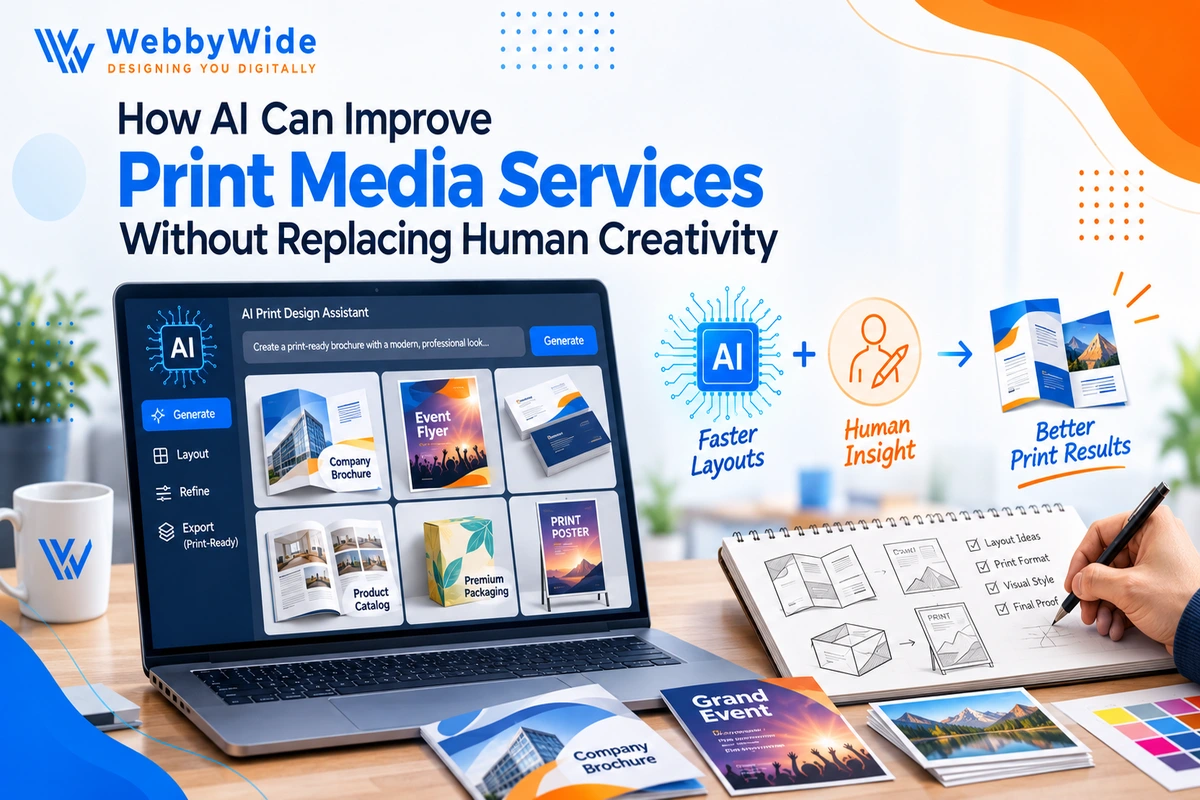
How AI Can Improve Print Media Services Without Replacing Human Creativity
There's a funny thing about print design. You can spend three hours getting a brochure to look just right, only to discover that the photographs aren't good enough for printing. Now you're back at your desk, fixing something that has very little to do with creativity.
This is where I find AI particularly useful. Forget the hype about machines becoming artists for a moment. Think about the everyday jobs that eat into a designer's working hours. Cropping photographs, cleaning up backgrounds, and checking hundreds of product descriptions all take time.
When businesses invest in Print Media Services, they shouldn't have to choose between creative quality and reasonable turnaround times. Modern design tools can help deliver both, provided someone with the right experience stays in charge of the work.
Where AI Fits Into Everyday Print Media Services
Suppose you run a small furniture store in Ohio and want to produce a spring catalog. You already have photographs of your products, but they come from different suppliers. Some have white backgrounds, others have shadows, and a few contain distracting objects.
Previously, a designer might have spent several hours cleaning up those photographs. Today, AI can handle much of that initial editing. The designer still needs to check the results, particularly around fine edges, fabrics, and reflective surfaces.
I see this as a sensible use of technology. Instead of spending most of the budget fixing photographs, you can put more of it toward the catalog's layout, product presentation, and overall design.
Naturally, businesses need to establish a few boundaries. The NIST AI Risk Management Framework offers guidance on responsible AI use. For design teams, this includes checking generated content for inaccuracies and handling client information with care.
Good Print Media Services Begin With Understanding the Customer
You can't design a useful restaurant menu without knowing something about the restaurant. Does it serve quick lunches to office workers? Is it a family-owned Italian restaurant where people spend two hours over dinner?
Those details affect everything from the font size to the way the designer presents each dish. Even the amount of information on a single page makes a difference.
AI can suggest menu layouts, but it needs direction. Someone must explain the business, its customers, and the experience it wants to create. That's a large part of what professional Print Media Services should offer.
The software comes into the picture after those conversations, not before them.
Making Photographs Work Better in Print
I've always considered image selection one of the more important parts of preparing artwork. You can change a font in seconds, but fixing unsuitable photographs often requires considerably more work.
Most small businesses have plenty of digital photographs. Finding ones suitable for a large printed advertisement is another matter. A photograph might look perfectly sharp on a six-inch phone screen and noticeably blurry on a full-page flyer.
AI image enhancement can help with certain problems. Designers can reduce noise, improve contrast, and enlarge suitable images. Nevertheless, excessive enhancement can change how a product actually looks.
For that reason, Print Media Services should involve checking the original and edited photographs side by side. A customer who orders a navy blue jacket shouldn't receive something that looks completely different from the catalog.
AI-Assisted Print Media Services Can Make Revisions Easier
A client approves a promotional flyer on Monday. On Tuesday, the price changes. By Wednesday, the business decides to extend the promotion and include another product.
Anyone who manages marketing projects probably recognizes that situation.
Small revisions become surprisingly time-consuming when they affect several different designs. AI-assisted editing tools can help designers adjust layouts, explore alternative image placements, and update selected elements more efficiently.
Looking at how AI is transforming graphic design, I find these practical improvements more interesting than the ability to generate an entire design from a short instruction.
For companies that regularly use Print Media Services, easier revisions can make seasonal campaigns considerably less stressful.
The Printing Mistakes That AI Can Help You Avoid
There's no undo button once your local printer finishes producing 3,000 flyers.
An incorrect address, missing digit in a telephone number, or outdated promotional offer can make an entire order unusable. AI proofreading tools may help catch some errors, while standard prepress software handles many technical checks.
However, neither tool knows whether your business recently changed its opening hours. Someone needs to supply and verify that information.
Here are several things I recommend checking before approving a print order.
|
Printing Detail |
What You Need to Check |
|
Image quality |
Aim for 300 PPI at the final size for most close-view printed materials. |
|
Bleed |
Many U.S. printers request an additional 0.125 inches around trimmed artwork. |
|
Color settings |
Follow the printing company's required color profile. |
|
Text placement |
Keep important information away from trimming and folding areas. |
|
Contact information |
Check phone numbers, website addresses, and business locations. |
|
QR codes |
Scan the code from an actual-size proof before approving production. |
Always confirm these specifications with your printer. Large-format printing, packaging, and specialty materials may require different settings.
Experienced Print Media Services combine these technical checks with careful visual inspection. Even a basic printed proof can reveal readability problems that you might miss on a monitor.
Can AI Improve Print Media Services for Direct Mail Campaigns?
A postcard advertising lawn care services might work well for homeowners with large yards. Sending that same postcard to apartment residents probably won't produce much business.
Personalization doesn't need to involve anything particularly complicated. Sometimes, changing the offer, photograph, or headline makes a marketing piece more relevant.
AI can help businesses organize approved customer information and develop different advertising messages. Combined with variable data printing, it allows businesses to produce multiple versions of a postcard or promotional letter.
Consider a dental practice in Arizona. It could create separate campaigns for routine checkups and cosmetic consultations, each with different information suited to its audience.
Print Media Services can help maintain a consistent appearance across these campaigns without making every piece identical. Businesses must also respect customer privacy, particularly when dealing with sensitive personal information.
Give Designers the Freedom to Try Something Different
One thing I dislike about template-heavy design is how quickly everything starts looking familiar. Walk through a shopping district and notice how many businesses use similar signs, fonts, and promotional layouts.
AI could make that problem worse if designers accept every suggestion without questioning it. On the other hand, it could also give them more freedom to explore unusual ideas.
A designer working on packaging for a small coffee roaster might experiment with vintage illustrations, handwritten lettering, or simple geometric patterns. Some ideas won't work. That's perfectly normal.
Exploring different AI tools for graphic designers can help creative teams test those possibilities before investing hours in detailed artwork.
The value of Print Media Services comes from developing the promising ideas further. Generating options is the easy part. Choosing the right one requires taste and judgment.
Why Paper Still Matters in AI-Assisted Print Media Services
Here's a question worth asking: would you print a luxury jewelry catalog on the same paper as a takeaway pizza menu?
Probably not.
Paper changes the character of a design. A textured, uncoated stock might suit a handmade furniture brand, while a glossy finish could work well for a catalog featuring colorful cosmetics.
Even the thickness of a business card influences how it feels when someone receives it. These decisions rarely attract much attention during the initial design stage, yet they contribute significantly to the finished product.
AI can help visualize certain finishes, but physical samples offer a better way to judge them. Ask your provider of Print Media Services about paper options before committing to production, especially for premium marketing materials.
Keeping Your Brand Recognizable Without Repeating the Same Design
A recognizable brand doesn't need to put the same layout on every piece of advertising. You can change the photography, arrangement, and headline while keeping the visual identity intact.
This becomes easier when a business establishes clear design guidelines. A good starting point involves professional logo design, along with suitable typography and a defined color palette.
AI can help organize approved assets and adapt layouts for various formats. Human designers decide how much flexibility each campaign needs.
For example, a children's clothing retailer might use playful graphics in its summer catalog and a simpler design for its in-store price lists. Both materials still belong to the same business.
Well-planned Print Media Services allow this kind of flexibility without losing brand recognition.
What AI Should Handle in Print Media Services
Rather than asking whether artificial intelligence can replace designers, I would ask which jobs actually benefit from automation.
Some tasks require patience more than imagination. Others depend heavily on understanding people, business objectives, and visual communication.
|
Let AI Assist With |
Keep Designers Responsible For |
|
Routine background removal |
Original visual concepts |
|
Preliminary layout suggestions |
Creative direction |
|
Basic photograph enhancement |
Accurate product representation |
|
Proofreading suggestions |
Final content verification |
|
Repetitive design adjustments |
Brand consistency |
|
Organizing creative assets |
Print quality and final approval |
This isn't a rigid division of responsibilities. Different projects require different approaches. However, it gives businesses a reasonable starting point when evaluating AI-powered Print Media Services.
Can AI Make Print Media Services More Affordable?
Sometimes it can, although I wouldn't assume that every project will suddenly cost less.
A simple promotional flyer might require fewer editing hours when a designer uses AI. A 60-page catalog with detailed product descriptions, hundreds of photographs, and complicated layouts remains a substantial assignment.
Businesses can often reduce costs more effectively by preparing their information properly. Supply accurate prices, high-quality photographs, approved logos, and clear instructions before the designer starts.
Ask your Print Media Services provider which activities AI helps streamline and how that affects the overall project cost. You want a transparent quote, not a vague promise of cheaper design.
Choosing Print Media Services That Use AI Responsibly
You don't necessarily need to know which software a creative agency uses. What matters more is how the team manages your project.
Before hiring someone, I would check a few things:
- Can the team show examples of finished printed work?
- Who reviews AI-generated photographs and illustrations?
- Does the service include print-ready artwork?
- How does the team manage commercial image licensing?
- Can you approve a proof before printing begins?
Pay particular attention to image ownership. AI platform terms vary, and commercial usage permission doesn't automatically eliminate every copyright or trademark concern.
Trustworthy Print Media Services should explain these limitations instead of pretending every generated image is suitable for unrestricted commercial use.
Conclusion
AI has a useful place in the print industry. It can save designers hours of repetitive editing, help businesses manage revisions, and make artwork preparation more efficient. But the smaller details that make print design memorable, from thoughtful typography to choosing the right paper, still benefit from human experience. That's where professional Print Media Services make a difference.
If your business needs a new brochure, product catalog, business card, or advertising campaign, Get in touch with our design team. We can discuss your ideas and help you develop printed marketing materials that feel right for your business.
Frequently Asked Questions
How AI Can Improve Print Media Services
AI helps designers complete routine tasks, including background removal, photo editing, layout adjustments, and proofreading. Designers can then dedicate more time to developing creative concepts and checking the finished artwork.
AI may reduce the amount of manual work involved in certain assignments. However, creative direction, customer understanding, brand development, and final print approval continue to require human judgment.
Yes. Small businesses that frequently update menus, flyers, catalogs, or promotional materials may benefit from more efficient editing and design workflows. The actual savings depend on the project requirements.
You can use suitable AI-generated images after checking commercial usage terms, copyright concerns, image quality, and printing specifications. Always review generated images for visual inaccuracies before publishing them.
Work with experienced designers, follow your printer's technical specifications, check image resolution, verify written information, and review a final proof. These basic steps help prevent unnecessary printing mistakes.
Comments
Add Comments
Update Comment