
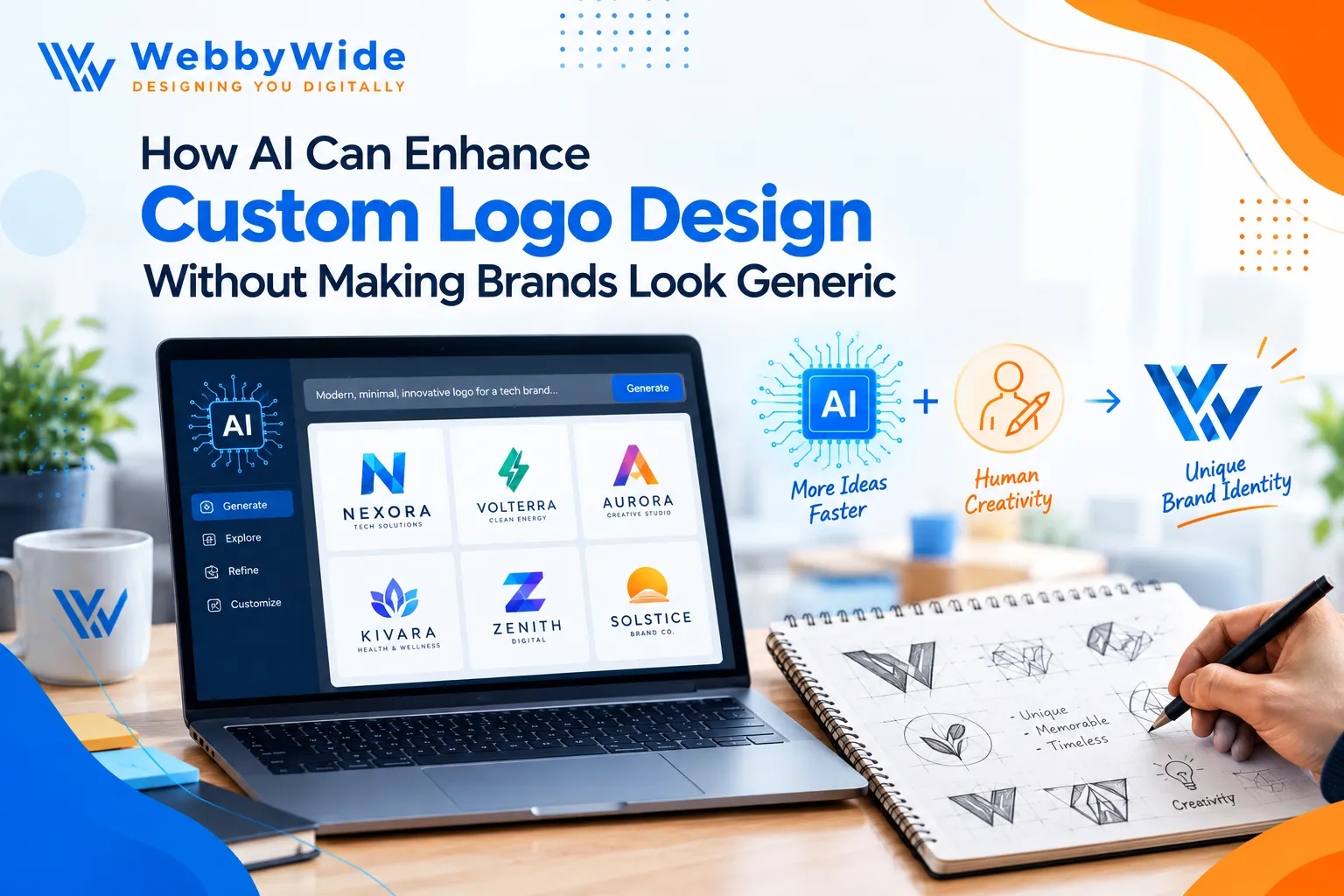
How AI Can Enhance Custom Logo Design Without Making Brands Look Generic
Your logo has about three seconds to make an impression. That is roughly enough time to recognize a coffee order, glance at a notification, and decide whether a brand looks like it belongs in your world-or in the endless digital junk drawer.
That pressure makes Custom Logo Design more important, not less. And now that AI can generate dozens of concepts before your coffee gets cold, the real challenge isn't creating more logos. It’s creating one that actually feels like your brand.
AI Changed the Logo Game. It Didn't Replace Taste.
I’ve watched AI move from a futuristic curiosity to an everyday creative tool. Today, designers can use it to explore visual directions, test compositions, generate moodboards, investigate typography ideas, and speed up repetitive tasks.
That makes Custom Logo Design faster in some ways. However, speed can create a strange problem: when everyone uses similar prompts, similar tools, and similar visual trends, brands can start looking suspiciously alike.
That’s where I think human direction matters most. Strong Custom Logo Design starts with strategy, personality, audience research, and a clear idea of what the business should communicate. AI can help me explore the territory, but I still need to decide where the brand should go.
Why AI Logos Sometimes Look So Generic
Let’s be honest: you’ve probably seen the AI logo look.
A clean sans-serif wordmark. A mysterious gradient. Maybe a geometric icon that resembles three overlapping circles. It looks polished, technically competent, and completely forgettable.
The problem doesn't necessarily come from AI itself. It often comes from using AI without enough creative direction.
I can ask an AI system to “create a modern luxury logo for a technology company,” and it can quickly produce attractive concepts. But “modern,” “luxury,” and “technology” describe thousands of businesses. Without deeper brand information, the result can easily drift toward familiar visual patterns.
That’s why I treat AI as a creative assistant rather than an art director.
Before I use it, I want to understand:
- What does the company actually sell?
- Who should immediately recognize its value?
- What emotion should the logo create?
- What competitors already dominate the visual space?
- Where will the logo appear?
- What makes the brand genuinely different?
- What visual ideas should I avoid?
For businesses that also need to protect a distinctive brand identity, I recommend checking the U.S. trademark landscape before falling in love with a final concept. The USPTO trademark resources provide useful guidance for researching trademarks and understanding the registration process.
Custom Logo Design Still Needs a Human Point of View
AI can produce options. I provide judgment.
That distinction sounds simple, but it changes everything.
Imagine asking ten people to decorate the same apartment using the instruction “make it stylish.” You’ll probably see some beautiful rooms. You’ll also see plenty of beige sofas, black metal lamps, plants, and minimalist artwork.
The same thing happens with AI-generated branding.
If I start with a generic prompt, I often get a generic visual language. If I start with a strong brand strategy, I can use AI to investigate unusual directions that support the identity.
This approach also connects with the broader conversation around how AI is transforming graphic design. AI doesn't simply give designers a faster paintbrush. It changes how we explore, compare, refine, and organize creative ideas.
The key word remains direction.
Use AI for Exploration, Not Identity
I like AI most during the messy middle of the creative process.
That’s the stage when I have a general direction but haven't committed to one visual solution. AI can help me explore hundreds of possibilities quickly.
For example, imagine I’m developing a logo for a fictional American outdoor apparel company. Instead of asking AI for “an outdoor clothing logo,” I can build a much more specific creative brief:
Rugged but refined. Pacific Northwest influence. Premium rather than tactical. Strong enough for embroidery. Works in one color. Avoid mountains, trees, compass icons, and obvious hiking symbols.
Now I’ve created boundaries.
Those boundaries actually make creativity more interesting. They force the process away from the first obvious answer.
I can then use AI tools for graphic designers to investigate typography, visual references, layouts, moodboards, and concept directions without automatically treating every generated image as a finished logo.
That last part matters.
A concept isn't a brand identity.
Five Ways AI Can Improve Custom Logo Design
1. AI Can Expand the First Round of Ideas
The first idea rarely deserves the crown.
AI can help me generate variations around a creative direction, which gives me more territory to explore before I settle on a concept.
I might investigate different visual weights, proportions, symbols, compositions, and stylistic approaches. Instead of spending hours manually creating every rough variation, I can use AI to accelerate the exploratory stage.
That gives me more time for the work that actually requires judgment.
2. AI Can Help Spot Overused Visual Trends
AI can also work as a reality check.
If a concept resembles hundreds of common logos, I want to know before the brand launches. A visual audit can help me identify familiar symbols, predictable typography choices, and design trends that already feel saturated.
That doesn't mean I should avoid every trend. Trends can make a brand feel current.
However, I don't want a logo that screams 2026 so loudly that it looks painfully dated by 2029.
Good Custom Logo Design balances relevance with longevity.
3. AI Can Speed Up Competitive Research
Competitive research often reveals what a brand should not look like.
I can analyze a category and identify recurring visual patterns. Maybe every competitor uses blue. Perhaps every financial company uses abstract arrows. Maybe every wellness brand has the same soft serif typography and muted earth tones.
That information creates an opportunity.
Instead of asking, “How can I look like the competition?”
I can ask, “Where can I create useful visual distance?”
That difference can transform Custom Logo Design from decoration into strategy.
4. AI Can Help Test Different Applications
A logo shouldn't only look good inside a presentation deck.
I want to know how it performs on a website header, social profile, business card, storefront sign, product package, mobile screen, presentation, and embroidered shirt.
AI can help visualize concepts in different environments quickly.
However, I still need to test the actual logo files at real sizes. A gorgeous presentation mockup can't rescue a mark that turns into visual soup when someone shrinks it to 32 pixels.
5. AI Can Make Iteration Faster
Great Custom Logo Design rarely emerges perfectly on the first attempt.
Clients react. Designers refine. Colors change. Typography gets adjusted. A symbol becomes simpler. Something that looked clever on Tuesday suddenly looks ridiculous on Friday.
That’s normal.
AI can accelerate some of those iterations, allowing me to explore alternatives without rebuilding every concept from scratch.
The faster I can test an idea, the faster I can discover whether it deserves to survive.
AI vs. Human Creativity: Who Should Do What?
|
Creative Task |
AI Helps With |
Human Leads |
|
Idea generation |
Yes |
Yes |
|
Brand strategy |
Limited |
Essential |
|
Concept exploration |
Excellent |
Essential |
|
Competitor analysis |
Helpful |
Essential |
|
Typography exploration |
Helpful |
Essential |
|
Emotional interpretation |
Limited |
Essential |
|
Final creative direction |
No |
Essential |
|
Brand consistency |
Helpful |
Essential |
|
Trademark considerations |
Research support |
Essential |
|
Final logo execution |
Assistance |
Essential |
The pattern should feel obvious: AI can support the process, but I don't want it making every important decision.
The Secret Weapon: A Strong Creative Brief
If you want better AI-assisted Custom Logo Design, improve the brief before improving the prompt.
A weak brief says:
“Create a modern logo for a professional company.”
A stronger brief tells me:
“Create a confident identity for a Chicago-based architecture studio serving ambitious residential clients. The brand should feel intelligent, warm, precise, and quietly luxurious. Avoid generic buildings, rooflines, and initials.”
Now I have something to work with.
The second brief creates constraints, and constraints often produce better creative thinking.
I can also define the brand through five simple categories:
- Personality — bold, refined, playful, serious, rebellious, approachable.
- Audience — who should immediately connect with the brand?
- Positioning — what makes the business different?
- Visual territory — what should the brand look and feel like?
- Visual no-go list — what symbols, styles, or trends should I avoid?
This approach gives Custom Logo Design a strategic foundation instead of letting AI choose the personality by default.
Don't Let “Minimal” Become “Meaningless”
Minimalism still dominates modern branding, and I understand why.
A simple logo works well on smartphones. It scales easily. It looks clean on websites. It can perform beautifully across packaging, signage, social media, and digital advertising.
But minimal doesn't mean empty.
A strong minimalist logo can contain subtle meaning through proportion, negative space, typography, shape, color, or an unexpected visual reference.
I often think of it like tailoring. A plain black suit can look extraordinary when the cut, fabric, and details work together. Another black suit can look like something you grabbed five minutes before a job interview.
Both are “minimal.”
Only one has personality.
That's the standard I want from Custom Logo Design.
How to Keep an AI-Assisted Logo Distinctive
If you’re working with AI during your branding process, I recommend following a few practical rules.
Start with the brand, not the prompt.
Know what the business represents before asking AI to visualize it.
Avoid generic descriptors.
Words like “modern,” “professional,” and “innovative” don't provide enough creative direction on their own.
Build visual restrictions.
Tell yourself what you won't use. Eliminating obvious choices often reveals more interesting ones.
Generate widely, then narrow aggressively.
Don't fall in love with the first polished image.
Redraw and refine.
Treat AI concepts as raw material. Simplify shapes, correct spacing, refine typography, and create a coherent system.
Test real-world applications.
Check the logo at tiny, medium, and large sizes. Try monochrome. Try dark and light backgrounds.
Think beyond the symbol.
A logo doesn't work alone. Typography, colors, imagery, layout, voice, and brand behavior all contribute to recognition.
That final point separates a logo from an identity.
What the Best Custom Logo Design Looks Like in the AI Era
I don't think AI will make professional design irrelevant. I think it will raise the bar.
When basic visual production becomes easier, judgment becomes more valuable.
Anyone can generate 50 logo concepts. The difficult part involves knowing which concept has a reason to exist.
That's why I see the future of Custom Logo Design as a partnership between technology and human taste. AI can help me move faster, investigate more directions, and reduce repetitive work. Human designers still bring context, emotion, strategy, cultural awareness, restraint, and the ability to recognize when something simply feels right.
And that last part remains surprisingly difficult to automate.
A great logo doesn't need to shout.
It needs to be recognizable when everything around it gets noisy.
Conclusion
AI has changed the creative process, but I don't see that as bad news for brands. In fact, I see a huge opportunity.
The smartest approach to Custom Logo Design doesn't involve choosing between AI and human creativity. It combines both. I can use AI to explore more possibilities, challenge predictable ideas, speed up iterations, and investigate new visual directions. Then I can apply strategy, taste, experience, and human judgment to turn those possibilities into a distinctive identity.
Your brand deserves more than a logo that looks good in an AI gallery.
It deserves a visual identity that people remember.
If you're ready to build a distinctive identity that uses modern technology without sacrificing personality, get in touch with our design team and start the conversation. Your next logo shouldn't look like everybody else's-and with the right strategy, it won't.
Frequently Asked Questions
Can AI create a completely original logo?
AI can generate original-looking concepts, but I wouldn't automatically assume that every output represents a unique, legally safe, or strategically distinctive identity. I recommend human review, competitive research, and appropriate trademark research before using a logo commercially.
Will AI make all logos look the same?
Not necessarily. Generic prompts and trend-heavy references can produce similar-looking results, but strong creative direction can push AI-assisted concepts into more distinctive territory.
Is AI good for Custom Logo Design?
Yes, when I use it as part of the creative process rather than as a complete replacement for strategy and design judgment. AI works particularly well for exploration, variations, moodboards, and early-stage ideation.
Should I use an AI-generated logo for my business?
You can explore AI-generated concepts, but I recommend having a professional designer refine the final identity. Your logo needs to work across real applications, remain consistent, and support your broader brand strategy.
How can I make an AI-generated logo look less generic?
Start with a detailed brand brief, avoid predictable symbols, establish clear visual restrictions, explore multiple directions, and refine the strongest concept manually. Strong Custom Logo Design starts with differentiation, not decoration.
Does professional logo design still matter with AI?
Absolutely. AI can increase creative speed, but professional design brings strategy, judgment, refinement, consistency, and practical experience. Those elements still determine whether a logo becomes memorable or simply becomes another image in someone's downloads folder.

Comments
Add Comments
Update Comment