
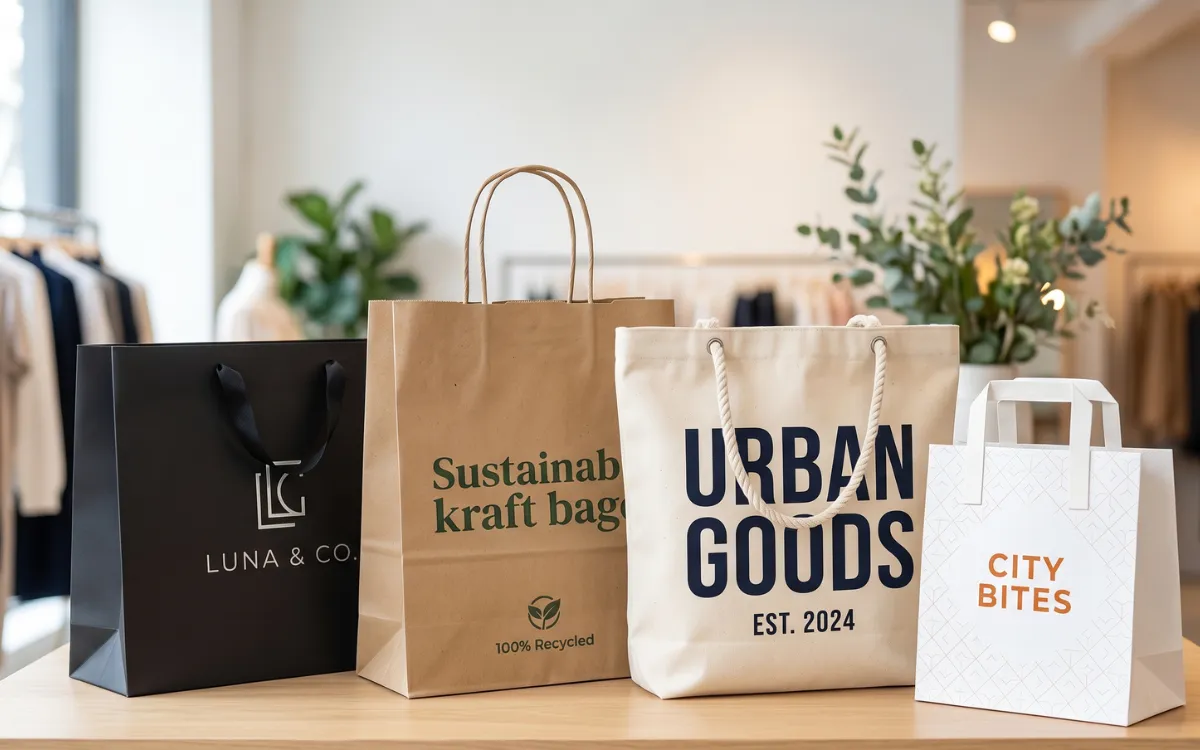
Can AI Improve Creative Carry Bags Without Losing Brand Identity?
Think about the last shopping bag that actually made you stop and look twice. Maybe it had a bold illustration, an unexpectedly clever phrase, or a design so clean it looked like it belonged in a Manhattan gallery. That little bag did more than carry a purchase. It carried a brand.
That’s exactly why Creative Carry Bags still matter in an era when nearly everything feels digitally generated. AI can produce hundreds of design ideas in minutes, but can it create a bag that feels unmistakably you?
The answer starts with understanding what Creative Carry Bags actually do. They turn an ordinary packaging item into a mobile brand statement. Whether you run a boutique in Brooklyn, a beauty label in Los Angeles, or a growing e-commerce business in Austin, the right Creative Carry Bags can make every customer interaction feel more intentional.
Why Creative Carry Bags Still Matter
I like to think of a branded carry bag as a tiny billboard with better manners.
It travels through coffee shops, sidewalks, offices, airports, and neighborhoods without asking anyone to click an ad. Someone carries your bag through downtown Chicago, and suddenly your brand gets another few seconds of attention from everyone nearby.
That makes Creative Carry Bags more than packaging. They can reinforce your visual identity, create memorable customer experiences, and give people another reason to remember your business.
For modern brands, that matters because customers often experience a company through several visual touchpoints before they ever become loyal. Your website, social media, packaging, storefront, logo, and even your shopping bag should feel like they belong to the same family.
Where AI Enters the Creative Process
AI changes the speed of design.
I can use AI to explore different visual directions, generate concept variations, test color combinations, brainstorm slogans, or experiment with layouts before committing serious design time to one direction.
That speed can make Creative Carry Bags much easier to develop, especially when a brand wants several concepts before selecting a final design.
AI can also help designers investigate how AI is transforming graphic design by making early-stage exploration faster and more flexible.
But there’s a catch.
AI can generate a lot. It doesn't automatically understand why one visual feels like your brand and another feels like something pulled from a completely different universe.
And that distinction matters.
AI Can Generate Ideas. Your Brand Gives Them Meaning.
Imagine asking an AI system to design a luxury fashion bag.
You might receive elegant typography, muted colors, minimal graphics, and sophisticated photography. It looks polished.
Now imagine your actual brand uses playful illustrations, bright colors, unusual typography, and a slightly rebellious personality.
The AI-created concept may look fantastic. It may even look more "premium" according to generic design conventions.
But it could still be completely wrong for you.
That’s the central challenge with Creative Carry Bags and AI: good design isn't automatically good branding.
Your brand identity gives every design decision context.
Before using AI, I would define:
- Your primary and secondary brand colors
- Typography preferences
- Logo usage rules
- Illustration or photography style
- Tone of voice
- Target audience
- Desired emotional response
- Packaging materials and finishes
- Visual elements customers already associate with you
Once I establish those boundaries, AI becomes much more useful.
Instead of saying, “Make me a cool shopping bag,” I can give the system a much clearer creative brief.
That difference can dramatically improve the starting concepts for Creative Carry Bags.
U.S. Copyright Office — Copyright and Artificial Intelligence
The Biggest Risk: Every Brand Starts Looking the Same
Here’s where things get interesting.
AI makes creativity faster, but widespread access to similar tools can also create visual sameness.
If thousands of businesses ask AI for “modern luxury packaging,” they may receive variations of the same familiar visual language: minimalist layouts, fashionable serif fonts, neutral colors, lots of whitespace, and carefully positioned product photography.
Beautiful? Absolutely.
Distinctive? Not necessarily.
That creates a major opportunity for businesses willing to use AI as a creative assistant rather than a creative replacement.
With Creative Carry Bags, originality often comes from the details.
A surprising color combination. A clever illustration. A pattern inspired by the local community. A playful message printed inside the bag. An unexpected handle treatment. A visual reference that only makes sense when someone knows your brand.
AI can help me explore those directions, but I still need human judgment to decide which idea deserves to exist.
How to Use AI Without Losing Your Brand Identity
I recommend treating AI like a very fast junior creative partner.
Give it direction. Give it constraints. Then edit the results aggressively.
1. Start With Your Brand, Not the AI
Before opening an AI design tool, collect your existing visual assets.
Your logo, color palette, typography, packaging examples, photography style, website, and previous campaigns can create the foundation for your concept.
If your brand already has strong visual recognition, don't throw that away simply because AI can generate something new.
For Creative Carry Bags, consistency often matters more than novelty.
2. Build Several Creative Directions
Instead of asking AI for one final design, create multiple creative territories.
For example:
Concept A: Minimal Luxury
Clean typography, restrained colors, premium materials, and plenty of breathing room.
Concept B: Bold & Playful
Oversized graphics, energetic colors, expressive typography, and a youthful personality.
Concept C: Local Storytelling
Illustrations or patterns inspired by your city, neighborhood, culture, or customer community.
This approach makes AI useful during the exploration stage without allowing it to dictate the final identity.
3. Protect Your Signature Elements
Your logo should remain recognizable.
Your core colors should still feel familiar.
Your typography should support your existing identity.
Your visual language should connect naturally with your website and other marketing materials.
When I look at successful Creative Carry Bags, I don't want to see a completely disconnected piece of artwork. I want to recognize the brand before I even read its name.
That’s the real test.
Can AI Make Creative Carry Bags More Personalized?
Yes, and this may become one of the most interesting opportunities.
AI can help brands develop different variations for seasons, product launches, locations, events, or customer segments.
A coffee brand might create a summer illustration series. A clothing retailer could develop limited-edition bags around a new collection. A local business might create neighborhood-specific artwork.
Instead of one generic design printed forever, brands can experiment with smaller creative collections.
This flexibility can make Creative Carry Bags feel more collectible.
And let's be honest: people love a limited edition.
If a customer likes the bag enough to reuse it at the gym, grocery store, or office, your packaging has officially graduated from disposable container to brand merchandise.
AI Tools Can Speed Up the Design Workflow
The growing selection of AI tools for graphic designers can help designers brainstorm, generate visual references, explore concepts, remove repetitive tasks, and develop variations.
However, I wouldn't use every tool simply because it exists.
The better question is: What part of the creative process actually needs help?
If brainstorming takes too long, use AI for ideation.
If you need visual exploration, use AI for concept development.
If you need repetitive production assistance, automate those tasks where appropriate.
If you need a final brand system, typography strategy, logo refinement, or art direction, bring human expertise back into the room.
For businesses developing Creative Carry Bags, that balance can save time without sacrificing personality.
Don't Let AI Design Your Entire Brand
This might sound obvious, but it deserves emphasis.
AI should not become the brand manager.
Your identity needs human decisions behind it.
For example, if you're launching a premium skincare brand, your packaging needs to communicate more than "luxury." It needs to communicate your version of luxury.
Maybe that's understated and architectural.
Maybe it's warm and botanical.
Maybe it's colorful and unapologetically playful.
AI can explore all three.
Only your brand strategy can determine which one actually belongs to you.
The same principle applies to Creative Carry Bags. A designer should review AI-generated concepts for visual consistency, practical production requirements, readability, originality, and alignment with the broader customer experience.
What Should You Check Before Printing?
A concept can look spectacular on a screen and completely different in the real world.
Before approving Creative Carry Bags, check:
|
Design Area |
What to Check |
|
Logo |
Is it clear and recognizable? |
|
Colors |
Will the printed colors match your brand expectations? |
|
Typography |
Can customers read the text quickly? |
|
Layout |
Does the design work from different viewing angles? |
|
Handles |
Do they complement the overall design? |
|
Material |
Does the artwork suit the chosen bag material? |
|
Printing |
Can your printer reproduce the details accurately? |
|
Brand consistency |
Does the bag look like part of your existing identity? |
|
Practicality |
Can customers comfortably carry and reuse it? |
This step separates a clever concept from effective packaging.
What About Professional Logo Design?
Your bag cannot rescue a weak visual identity.
If your logo looks outdated, difficult to read, or inconsistent across platforms, AI-generated packaging may simply make the problem more noticeable.
That’s why brands should consider professional logo design as part of a broader visual identity strategy.
A strong logo gives your Creative Carry Bags a recognizable anchor.
From there, your packaging can experiment with patterns, illustrations, typography, photography, and messaging while still maintaining a connection to the parent brand.
The Human Touch Still Wins
I’ve seen plenty of AI-generated designs that look impressive within seconds.
I’ve also seen designs that technically look perfect but feel strangely empty.
That difference usually comes down to human context.
A designer understands why a particular image resonates with a customer. They understand when a trend feels authentic and when it feels like you're chasing the algorithm. They can recognize when a layout looks fashionable but doesn't communicate clearly.
AI doesn't need to disappear from the process.
Instead, I think the strongest future for Creative Carry Bags combines machine speed with human taste.
AI can give me 50 directions.
A good designer can tell me which five deserve attention.
A great brand strategist can explain which one actually belongs to the brand.
Conclusion
AI can make the creative process faster, broader, and more experimental. But speed doesn't create brand identity. You do.
The strongest Creative Carry Bags won't necessarily come from the most complicated AI prompt. They'll come from a clear understanding of the brand, a strong creative direction, smart technology, and someone willing to edit the details until everything feels right.
Think of AI as your idea machine. Let it throw possibilities onto the table.
Then bring human taste, strategy, storytelling, and design expertise back into the conversation.
Because when someone walks down a New York street carrying your bag, you don't want them to think, "Nice AI design."
You want them to think, "I know that brand."
If you're ready to turn your packaging into a stronger part of your visual identity, get in touch with our design team and start exploring what your next Creative Carry Bags could look like.
Frequently Asked Questions About Creative Carry Bags and AI
AI can generate visual concepts and design directions, but I recommend using those concepts as starting points rather than automatically treating them as finished packaging. It can. Generic prompts often produce generic results. Strong brand guidelines, creative direction, editing, and human review can help create more distinctive Creative Carry Bags. Start with your existing logo, colors, typography, imagery, messaging, and visual guidelines. Use those elements to establish boundaries before generating new concepts. Yes. A well-designed bag can extend a customer's interaction with a brand beyond the point of purchase. Reusable and visually distinctive packaging can also become part of everyday life. Absolutely. I recommend human review for brand consistency, typography, composition, production requirements, originality, and final print preparation. Yes. AI can help generate variations for seasonal campaigns, product launches, events, locations, and limited editions while designers maintain consistent brand standards. Can AI Improve Creative Carry Bags
Comments
Add Comments
Update Comment