
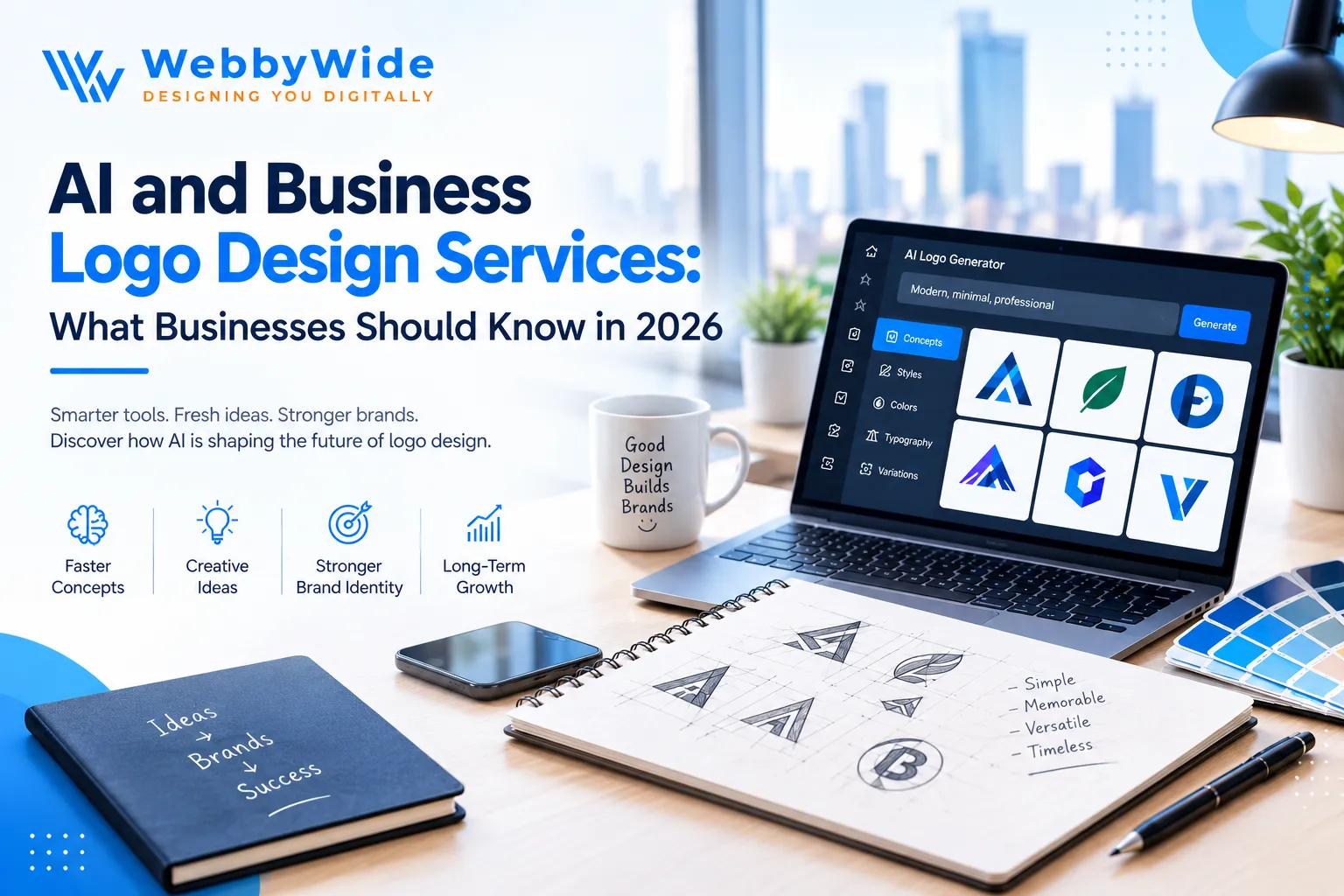
AI and Business Logo Design Services: What Businesses Should Know in 2026
Your logo has about three seconds to make an impression. In a world where Americans scroll, swipe, shop, and judge brands faster than ever, that tiny visual mark can carry a surprisingly heavy workload.
I see AI changing that workload in 2026. It can generate dozens of ideas before your first coffee gets cold, but a strong logo still needs strategy, personality, and a human eye. That is where Business Logo Design Services can make the difference between a logo that simply looks cool and one that actually feels like your brand.
AI Is Changing How Businesses Approach Logo Design
AI has made logo exploration faster. A startup founder can describe a mood, industry, color palette, or audience and receive multiple visual directions within minutes. For a small business with a tight budget, that speed can feel like finding an express lane through a crowded creative process.
However, speed does not automatically create identity.
I often compare AI to having an incredibly fast brainstorming partner who never sleeps but occasionally has questionable taste. It can throw ideas onto the table. You still need someone to decide which ideas deserve to stay there.
Modern logo design now combines technology with human judgment. Designers can use AI to explore concepts, test visual directions, experiment with typography, and create early mood boards. Then they refine those ideas around the company's positioning, customers, competitors, and long-term goals.
For businesses exploring the bigger creative shift, understanding how AI is transforming graphic design can provide useful context.
What AI Can Actually Do for Logo Design in 2026
AI can handle several parts of the creative process remarkably well. I would not treat it as a replacement for a professional designer, but I would absolutely treat it as another tool in the toolbox.
Here are some practical uses:
- Concept generation: AI can quickly produce multiple creative directions.
- Style exploration: You can test minimalist, vintage, luxury, geometric, playful, or editorial styles.
- Color experimentation: Designers can explore different palettes and visual moods.
- Typography ideas: AI can help suggest combinations of fonts and lettering styles.
- Visual references: Teams can create mood boards and early visual concepts faster.
- Iteration: Designers can explore variations without rebuilding every concept manually.
- Presentation: Teams can visualize how a logo might appear on packaging, websites, signage, or social profiles.
That speed matters, especially for U.S. startups and growing businesses that need to move quickly. Still, I would never judge a logo simply by counting how many concepts AI can produce.
The better question is: Does the final mark communicate something meaningful about the business?
AI Logo Design vs. Professional Human Design
This is where things get interesting.
AI can generate attractive visuals, but attractiveness alone does not create a memorable brand. A logo needs to work when someone sees it on a smartphone, business card, storefront, product label, LinkedIn profile, or giant highway sign.
Professional Business Logo Design Services bring strategic thinking into that process.
|
AI-Assisted Design |
Professional Human Design |
|
Generates ideas quickly |
Builds ideas around brand strategy |
|
Useful for exploration |
Refines concepts for real-world use |
|
Can create many variations |
Selects and develops the strongest direction |
|
Strong at visual experimentation |
Strong at context and decision-making |
|
May produce generic patterns |
Can create a distinctive brand identity |
|
Requires human review |
Includes human creative judgment |
I think the smartest approach in 2026 sits somewhere between the two. Let AI help with exploration, while an experienced designer controls the creative direction.
That combination can save time without turning your brand into something that looks like it came from the same template as 400 other businesses.
Why Originality Matters More Than Ever
AI has created an unusual branding problem: abundance.
We now have more visual content than ever. That sounds fantastic until you realize that thousands of businesses can ask similar AI systems for a "modern minimalist logo with blue and gold."
The result? Similar ideas can start appearing everywhere.
Your logo needs its own visual fingerprint. A designer can look beyond the obvious and ask more useful questions:
- What should customers remember?
- What makes the business different?
- What emotional response should the logo create?
- Will the concept still feel relevant five years from now?
- Does the design fit the company's market?
- Can the logo work without its tagline?
- Does it remain recognizable at small sizes?
Those questions form the foundation of effective Business Logo Design Services.
AI can help generate the ingredients. Human creativity decides what belongs on the plate.
What About Copyright and AI-Generated Logos?
This deserves attention in 2026.
The U.S. Copyright Office has stated that copyright protection can apply to AI-assisted work when a human contributes sufficient original expressive elements. Simply typing prompts into an AI system does not automatically create copyright protection for the resulting material.
That distinction matters for businesses.
Imagine spending thousands of dollars building a brand around a logo, only to discover later that the creative ownership situation feels murky. You do not want your brand strategy to begin with a legal headache.
For that reason, I recommend asking your designer or design provider:
- How do you use AI during the creative process?
- Which parts of the final logo involve original human design work?
- Do you provide editable source files?
- Do you check for obvious similarities with existing marks?
- What rights do I receive when the project ends?
- Can you create variations for different platforms?
A reputable provider should answer these questions clearly rather than hiding behind futuristic AI buzzwords.
The Rise of AI Tools for Designers
The modern designer's workflow looks very different from the one I remember from the early days of digital design.
Today, professionals can combine generative AI, vector software, typography platforms, image tools, mockup generators, and traditional design applications. These AI tools for graphic designers can accelerate research and experimentation without controlling the entire creative process.
That distinction matters.
I like to think of AI as the accelerator, not the steering wheel.
A designer still needs to understand spacing, hierarchy, contrast, typography, balance, visual identity, accessibility, and scalability. Those fundamentals determine whether a logo works in the real world.
What Makes a Strong Business Logo in 2026?
Trends come and go. Your logo should not need a complete personality transplant every eighteen months.
I see several qualities continuing to matter:
1. Simplicity
A clean logo can work across more situations. Think social avatars, mobile screens, merchandise, invoices, signage, and packaging.
2. Distinctiveness
A logo should have a recognizable idea behind it. Generic symbols rarely create memorable brands.
3. Scalability
Your logo should remain clear at 32 pixels and still look impressive on a storefront.
4. Strong Typography
Typography can communicate personality before someone reads a single word. Serif fonts can feel established. Sans-serif styles can feel modern. Custom lettering can create something more distinctive.
5. Flexible Color
Your logo should not collapse when someone prints it in black and white.
6. Brand Relevance
A financial company, craft brewery, law firm, fashion label, and children's brand should not all communicate the same visual personality.
These principles remain important whether a designer uses AI, traditional software, sketching, or a combination of all three.
How Much Should You Rely on AI for Your Logo?
I would avoid both extremes.
You do not need to reject AI because it feels new. You also do not need to hand your entire brand identity to an algorithm because it feels efficient.
Instead, consider AI-assisted Business Logo Design Services when you want faster ideation, broader experimentation, and efficient revisions.
Then make sure a human designer handles the strategic decisions.
A practical workflow might look like this:
Step 1: Define your brand personality.
Step 2: Research your competitors and audience.
Step 3: Generate multiple creative directions.
Step 4: Select the strongest concepts.
Step 5: Refine typography, spacing, shapes, and colors.
Step 6: Test the logo at different sizes and placements.
Step 7: Prepare final files for digital and print use.
Step 8: Build a simple brand guideline around the finished identity.
That process gives AI a useful role without letting technology dictate your entire visual identity.
Why Businesses Still Need Professional Logo Designers
Here is the part I think gets lost in all the AI excitement.
A logo is not just a picture.
It becomes the face people associate with your company.
When I look at successful brands, I see consistency. The logo works with the website. The colors work with the packaging. The typography works with the advertising. The entire system feels intentional.
That is where professional logo design becomes valuable.
A professional designer can challenge your first idea, identify visual problems, simplify complicated concepts, and create a system that works across multiple marketing channels.
Sometimes the best design decision involves removing something you really wanted to keep.
Yes, that hurts.
It also happens to be part of good design.
Questions to Ask Before Choosing Business Logo Design Services
Before hiring a designer or agency, I recommend asking a few practical questions:
- Do you provide multiple initial concepts?
- Will I receive vector files?
- Can you provide SVG, PNG, PDF, and other useful formats?
- Do you create versions for social media?
- Can you provide monochrome and reversed versions?
- Do you explain the reasoning behind your concepts?
- How do revisions work?
- How do you incorporate AI into your workflow?
- Do you perform originality or similarity checks?
- Will I receive the final editable files?
The answers can tell you far more than a flashy portfolio page.
Final Thoughts
AI has changed the speed of logo design, but it has not eliminated the need for taste, strategy, originality, or human judgment.
In 2026, I see the strongest Business Logo Design Services combining technology with creative thinking. AI can help designers explore more possibilities, move faster, and test ideas. Human designers still decide what makes sense for the brand.
That balance gives businesses something far more valuable than a pretty graphic: a visual identity that people can recognize, remember, and trust.
If your current logo feels dated, generic, or difficult to use across modern platforms, now is a good time to rethink it. Get in touch with our design team and start building a logo that feels ready for where your business is going next.
Frequently Asked Questions
AI-generated logos can help small businesses explore ideas quickly. However, I recommend human refinement before using a logo as your official brand identity. A professional can improve originality, usability, typography, and consistency. The U.S. Copyright Office focuses on human authorship when evaluating copyright protection. Human creative contributions can support protection, while merely providing prompts does not automatically create copyright protection for an AI-generated result. You can use both. AI can accelerate concept development, while a professional designer can handle strategy, refinement, originality, and practical brand applications. Modern Business Logo Design Services may use AI for brainstorming, visual exploration, mood boards, variations, and other early-stage tasks. Designers then apply human judgment to refine and finalize the identity. I recommend requesting vector files such as SVG, along with high-resolution PNG and PDF versions. You may also want black, white, transparent, horizontal, vertical, and icon variations. Yes. If many businesses use similar prompts and visual directions, their results can share common patterns. Human customization can help create a more distinctive identity. A strong logo can remain useful for many years when the designer builds it around the company's identity rather than a short-lived visual trend. You can refresh supporting elements later without completely replacing the core mark.AI and Business Logo Design Services

Comments
Add Comments
Update Comment